Today's
EarthStation1.com 15% (Or More!) Off Commemorative Memorial Title:
Classic Movie Trailers & Drive-In Movie Ads DVD, Download, USB
Drive
Today, October 23, 2026
October 23: International Swallows Depart
From San Juan Capistrano Day: -- Today's the day to witness the
mass migration and admire the natural grace and beauty of
swallows. Swallows are tiny, elegant birds with dark-blue backs
and white underparts. They have pumpkin-colored rumps and a light
patch on their forehead. Countless birds flock together and nest
inside San Juan Capistrano on or around October 23. These birds
spend their spring and summer in the church and return to
Argentina for the winter. People travel long distances to admire
the birds' natural beauty and grace. Most of us have a fantasy of
flying through the sky like Superman. But that is not likely to be
possible. But birds can do that on an everyday basis. Most birds
can dance with the winds and sing with the trees. However, we can
admire the grace and beauty of these remarkable birds instead of
fantasizing about being Superman. And October 23 is the best day
for that as swallows will nest at San Juan Capistrano in Orange
County, California. Swallows are a family of passerine birds found
worldwide and occasionally found even in Antarctica. Swallows are
also known as martins, saw-wings, or Hirundinidae. They evolved
around 22 million years ago. But they did not become this
widespread until the evolution of humans and the start of
agriculture. They are excellent insect hunters. Many species visit
agricultural lands and other human-altered landscapes, searching
for food and nesting grounds. There is an interesting legend about
the San Juan Capistrano church in California and the swallows. An
innkeeper destroyed the nests of swallows from the eaves of
buildings as he thought of them as filthy and a nuisance. Father
St. John O'Sullivan of the San Juan Capistrano happened upon this
moment and invited the birds to the Mission. He provided sanctuary
for the birds, and they started visiting the church every year
from that year.
https://store.earthstation1.com/classic-movie-trailers-and-drivein-movie-ads-dvds-2-disc-se2.html
Today's
EarthStation1.com 15% (Or More!) Off Commemorative Memorial Title:
Curse Of The Doll People aka Devil Doll Men 1961 DVD, MP4, USB
Drive
Today, October 23, 2026
October 23: National Horror Movie Day: --
If you love a good fright, today is the perfect day to promote the
beauty and cathartic thrills of being scared by great horror
movies! Halloween is in the air bringing together fans of witches,
ghouls, zombies, monsters, spiders, and pumpkins. Stores are
filled with everything Halloween fans love. In fact, Halloween is
a time when an abundance of horror movies are available for
viewing in theatres and on streaming apps. Horror movies have been
around since about 1886 when French filmmaker Georges Melies
created a short film called "Le Manoir du Diable" or The
Haunted Castle. The film was a mere three minutes long and
included witches, demons, and special effects that created
supernatural occurrences. Since then, horror movies have evolved
into different genres that consist of common elements. There are
are three main horror movie genres: 1) Fear and suspense horror
movies aim to make the audience feel fear or anxiety. They often
use suspenseful build-ups, jump scares, and eerie atmospheres to
achieve this; 2) Supernatural or paranormal horror films involve
supernatural or paranormal phenomena such as ghosts, demons,
monsters, vampires, zombies, or otherworldly forces. These
elements often serve as the source of fear; and 3) Psychological
horror movies delve into the psychological aspects of fear by
exploring themes like insanity, obsession, or the breakdown of the
human psyche. Movies like Psycho and The Shining are examples of
psychological horror. Horror films have been a significant part of
movie culture with classic and influential works that continue to
captivate audiences. The goal of any good horror movie is to
elicit strong emotional responses from the audience, including
fear and anxiety to shock and disgust. While some people watch
horror movies for the adrenaline rush and excitement, others enjoy
them for the psychological aspect horror movies offer. Every
horror movie capitalizes on the fear of being isolated or trapped
in a terrifying situation with no escape. Locations are always
isolated or remote, like haunted houses or remote cabins. The
survival of a character or characters depends on their
resourcefulness and how resilient they are while finding and
escape. A good horror movie knows music plays a critical role in
creating unnerving tension. In fact, the right kind of music and
sound can heighten a scene and scare anyone who is watching. One
of the most defying moments in horror movie history was the music
and sound effects playing during the film Psycho. Without the
effects of spine-chilling sound and music, Psycho would have been
just another film. All horror movies carry a dark theme that
explores death, taboo, madness, or the afterlife. Oftentimes,
horror movies also include social fear and anxiety with characters
to heighten the fear factor. However, dark themes are never
complete without the effect of makeup and visual effects to create
terrifying creatures and gruesome scenes for the characters. A
combination every horror movie requires.
https://store.earthstation1.com/curse-of-the-doll-people-aka-devil-doll-men-dvd.html
Today's
EarthStation1.com 15% (Or More!) Off Commemorative Memorial Title:
Jack Paar Late-Night TV Talk Shows DVD, MP4 Download, USB Flash
Drive
Today, October 23, 2026
October 23: National TV Talk Show Host
Day: -- Celebrated as a tribute to the king of late-night
television, Johnny Carson. America's love for talk shows goes back
to the 1950s. Generations come and go, hosts change, but the
conversation keeps flowing. A charming host, interviewing an array
of A-list celebrities, and a home delivery of some scalding-hot
gossip is a package made in heaven - and today is the day we
celebrate it all. For 30 years, Johnny Carson was an integral part
of our lives. His crisp monologues, non-partisan political satire,
self-deprecating jokes, and a sensitive style of questioning kept
us glued to our screens from Monday to Friday. Born in Corning,
Iowa, on October 23, 1925, Carson studied at the University of
Nebraska and graduated with a bachelor's degree in radio and
speech. After a short stint as a television writer for "The
Red Skelton Show" in Los Angeles, he moved to New York City
to pursue a bigger audience. After a couple of failed stints
across several major networks, he was offered the chance to take
over "The Tonight Show" at NBC. Following weeks of
hesitation, he finally agreed to the gig in 1962, and the rest is
history. Even after earning six Emmys, being inducted into the
Television Hall of Fame in 1987, and receiving a Presidential
Medal of Freedom award in 1992 for a career spanning decades,
Johnny remained humble to his Iowan roots. At age 66, Carson
stepped down as host of "The Tonight Show" on May 22,
1992, and entered into retirement. On January 23, 2005, he passed
away at the age of 79 due to respiratory failure caused by
emphysema. A T.V. talk show host wields immense influence over
their loyal audience. When delivering news, they are allowed to
let their zingy opinions penetrate the objective reporting -
making it all the more fun for their viewers. October 23 is a
great day to celebrate this challenging yet fulfilling profession.
https://store.earthstation1.com/jack-paar-tv-shows-old-time-television-dual-layer-dvd.html
Today's
EarthStation1.com 15% (Or More!) Off Commemorative Memorial Title:
Communism With Tanks: Hungarian &East Bloc Revolutions DVD,
MP4, USB
Today, October 23, 2026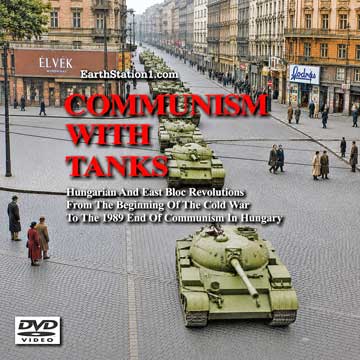
October 23, 1956: The Aftermath Of World
War II: The Cold War: Anti-Communist Insurgencies In Central And
Eastern Europe: The Hungarian Revolution Of 1956 (The Hungarian
Uprising): -- Secret police of The Hungarian State Protection
Authority (Allamvedelmi Hatosag, AVH) shoot dead several
anti-communist student and worker protesters in Budapest, sparking
The Hungarian Revolution Of 1956 (Hungarian: 1956-Os Forradalom),
a nationwide revolution against the Hungarian People's Republic
and its Soviet-imposed policies, lasting from October 23 until
November 10, 1956. Leaderless at the beginning, it was the first
major threat to Soviet control since the Red Army drove Nazi
Germany from its territory at the End of World War II in Europe.
The revolt began as a student protest, which attracted thousands
as they marched through central Budapest to the Hungarian
Parliament building, calling out on the streets using a van with
loudspeakers. A student delegation, entering the radio building to
try to broadcast the students' demands, was detained. When the
delegation's release was demanded by the protesters outside, they
were fired upon from within the building by the State Security
Police, known as the AVH (acronym for Allamvedelmi Hatosag,
literally "State Protection Authority"). Multiple
students died and one was wrapped in a flag and held above the
crowd. This was the start of the next phase of the revolution. As
the news spread, disorder and violence erupted throughout the
capital. The revolt spread quickly and the government collapsed.
Thousands organised themselves into militias, battling the AVH and
Soviet troops. During the revolt there were violent incidents;
some local leaders and AVH members were lynched or captured, while
former political prisoners were released and armed. Radical
impromptu workers' councils wrested municipal control from the
ruling Hungarian Working People's Party (Hu: Magyar Dolgozok
Partja) and demanded political change.The new government of Imre
Nagy formally disbanded the AVH, declared its intention to
withdraw from the Warsaw Pact and pledged to re-establish free
elections. By the end of October, fighting had almost stopped, and
the days of normality began to return. Some workers continued
fighting in opposition to both the Stalinist regime and the
appearances of "bourgeois" parties in its wake.
Initially appearing open to negotiating a withdrawal of Soviet
forces, the Politburo changed its mind and moved to crush the
revolution. On 4 November, a large Soviet force invaded Budapest
and other regions of the country. The Hungarian resistance
continued until November 10. Over 2,500 Hungarians and 700 Soviet
troops were killed in the conflict, and 200,000 Hungarians fled as
refugees. Mass arrests and denunciations continued for months
thereafter. By January 1957, the new Soviet-installed government
had suppressed all public opposition. These Soviet actions, while
strengthening control over the Eastern Bloc, alienated many
Western Marxists, leading to splits and/or considerable losses of
membership for communist parties in capitalist states.
#HungarianRevolutionOf1956 #HungarianRevolution
#HungarianUprisingOf1956 #HungarianUprising
#SovietOccupationOfHungary #EastBloc #CommunistBloc #SovietBloc
#WarsawPact #ColdWar ========= October 23: Hungarian Republic Day:
-- This day is honored in remembrance of two great events in
Hungary's history. First, when the people of Hungary stood up
against the Soviet Union, and second, the creation of Hungary in
1989. The Hungarian Revolution was an impulsive revolt that spread
throughout the whole of Hungary. The nation revolted against the
local government and the policies that were imposed on it by the
Soviets. The revolution lasted from October 23 till November 10,
1956. Despite the revolution's failure, it played a great role in
the fall of the Soviet Union many years later. The day also
celebrates the first free parliamentary election that led to the
declaration of Hungary as a free republic. The holiday is
celebrated throughout the country with exhibitions and speeches
that celebrate the Hungarian people and culture. Hungary had been
under the control of the Soviet Union after the Second World War
ended. Under the Stalinist government, thousands of non-communist
Hungarians were relocated, with their housing confiscated in an
attempt to consolidate the power of the government. A concerted
effort was made to control the country through cultural control.
The government introduced the Russian language and Communist
political philosophy in schools, and these studies were compulsory
for all students. There was a significant economic decline during
this time as well. Later on, when the democratic changes occurred
in Austria, the Hungarians were hopeful of the same adjustments.
Unfortunately, the hopes of the people of Hungary were shattered
after the establishment of the Warsaw Pact in 1955. To demand
democratic changes in Hungary and to gain freedom from the rule of
the Soviet Union, the students of Hungary held a protest in
Budapest in 1956. It was supported by most people and the number
of protestors grew, resulting in many protests across Hungary. The
Soviets tried to take back control by deploying tanks on the
streets of Budapest. As a result, the people of Hungary rebelled
against the local government and until the Soviets called for a
ceasefire and announced to carry out fair elections. The above
event is remembered as the Hungarian Revolution of 1956. To honor
this event, the Hungarians declared the Third Hungarian Republic
on October 23, 1989. The Hungarians demanded some changes be made
in the constitution of Hungary, which included permitting
multi-party politics, public assembly, and the establishment of a
power separation in the government. The official celebration for
this day was declared on October 23 in 1991 by the National
Assembly.
https://store.earthstation1.com/communism-with-tanks-dvd-hungarian-east-bloc-revolutions.html
Today's
EarthStation1.com 15% (Or More!) Off Commemorative Memorial Title:
The Second Russian Revolution TV Series DVD, Video Download, USB
Drive
Today, October 23, 2026
October 23: Hungarian Republic Day: --
This day is honored in remembrance of two great events in
Hungary's history. First, when the people of Hungary stood up
against the Soviet Union, and second, the creation of Hungary in
1989. The Hungarian Revolution was an impulsive revolt that spread
throughout the whole of Hungary. The nation revolted against the
local government and the policies that were imposed on it by the
Soviets. The revolution lasted from October 23 till November 10,
1956. Despite the revolution's failure, it played a great role in
the fall of the Soviet Union many years later. The day also
celebrates the first free parliamentary election that led to the
declaration of Hungary as a free republic. The holiday is
celebrated throughout the country with exhibitions and speeches
that celebrate the Hungarian people and culture. Hungary had been
under the control of the Soviet Union after the Second World War
ended. Under the Stalinist government, thousands of non-communist
Hungarians were relocated, with their housing confiscated in an
attempt to consolidate the power of the government. A concerted
effort was made to control the country through cultural control.
The government introduced the Russian language and Communist
political philosophy in schools, and these studies were compulsory
for all students. There was a significant economic decline during
this time as well. Later on, when the democratic changes occurred
in Austria, the Hungarians were hopeful of the same adjustments.
Unfortunately, the hopes of the people of Hungary were shattered
after the establishment of the Warsaw Pact in 1955. To demand
democratic changes in Hungary and to gain freedom from the rule of
the Soviet Union, the students of Hungary held a protest in
Budapest in 1956. It was supported by most people and the number
of protestors grew, resulting in many protests across Hungary. The
Soviets tried to take back control by deploying tanks on the
streets of Budapest. As a result, the people of Hungary rebelled
against the local government and until the Soviets called for a
ceasefire and announced to carry out fair elections. The above
event is remembered as the Hungarian Revolution of 1956. To honor
this event, the Hungarians declared the Third Hungarian Republic
on October 23, 1989. The Hungarians demanded some changes be made
in the constitution of Hungary, which included permitting
multi-party politics, public assembly, and the establishment of a
power separation in the government. The official celebration for
this day was declared on October 23 in 1991 by the National
Assembly.
https://store.earthstation1.com/the-second-russian-revolution-6-dvd-set-complete-tv-serie6.html
Today's
EarthStation1.com 15% (Or More!) Off Commemorative Memorial Title:
The World: A Television History Documentary Series DVD, Download,
USB
Today, October 23, 2026
October 23, 42 BC: The Crisis Of The
Roman Republic: Civil Wars Of The Roman Republic: The Liberators'
Civil War: The Battle Of Philippi: The Second Battle Of Philippi:
-- Brutus is defeated by Triumvirs Mark Antony and Octavian after
a hard-fought battle and commits suicide, leaving the Second
Triumvirate in control of the Roman Republic. The Battle Of
Philippi (First Battle Of Philippi: October 3, 42 BC; Second
Battle Of Philippi: October 23, 42 BC) was the final battle in the
Wars of the Second Triumvirate between the forces of Mark Antony
and Octavian (of the Second Triumvirate) and the leaders of Julius
Caesar's assassination, Marcus Junius Brutus and Gaius Cassius
Longinus in 42 BC, at Philippi in Macedonia. The Second
Triumvirate declared this civil war ostensibly to avenge Julius
Caesar's assassination in 44 BC, but the underlying cause was a
long-brewing class conflict between the ancien regime represented
in the Senate (Optimates), and the rising class (Populares). The
battle, involving up to 200,000 men in one of the largest of the
Roman civil wars, consisted of two engagements in the plain west
of the ancient city of Philippi. The First Battle Of Philippi was
fought when Triumvirs Mark Antony and Octavian engaged in a
decisive battle with Caesar's assassins Brutus and Cassius; Brutus
faced Octavian, and Antony's forces fought those of Cassius. The
Roman armies fought poorly, with low discipline, nonexistent
tactical co-ordination and amateurish lack of command experience
evident in abundance with neither side able to exploit
opportunities as they developed. At first, Brutus pushed back
Octavian and entered his legions' camp. However, to the south,
Cassius was defeated by Antony, and Cassius committed suicide
after hearing a false report that Brutus had also failed. Brutus
rallied Cassius's remaining troops, and both sides ordered their
army to retreat to their camps with their spoils. The battle was
essentially a draw but for Cassius's suicide. A second encounter,
on October 23, finished off Brutus's forces after a hard-fought
battle. He committed suicide in turn, leaving the triumvirate in
control of the Roman Republic.
https://store.earthstation1.com/the-world-a-television-history-4-dual-layer-dvds-all-26-sh426.html
Today's
EarthStation1.com 15% (Or More!) Off Commemorative Memorial Title:
Monarchy In The UK: British Royal History MP4 Video Download DVD
Set
Today, October 23, 2026
October 23, 1642: The European Wars Of
Religion: The Wars Of The Three Kingdoms (The British Civil Wars):
The English Civil War: The First English Civil War: The Battle Of
Edgehill (The Battle Of Edge Hill): -- The first major battle of
the English Civil War breaks out on a Sunday in a pitched battle
fought near Edge Hill and Kineton in southern Warwickshire, a
ceremonial county in the West Midlands of England. All attempts at
constitutional compromise between King Charles and Parliament
broke down early in 1642. Both the King and Parliament raised
large armies to gain their way by force of arms. In October, at
his temporary base near Shrewsbury, the King decided to march to
London in order to force a decisive confrontation with
Parliament's main army, commanded by the Earl of Essex. Late on
October 22, both armies unexpectedly found the enemy to be close
by. The next day, the Royalist army descended from Edge Hill to
force battle. After the Parliamentarian artillery opened a
cannonade, the Royalists attacked. Both armies consisted mostly of
inexperienced and sometimes ill-equipped troops. Many men from
both sides fled or fell out to loot enemy baggage, and neither
army was able to gain a decisive advantage. After the battle, the
King resumed his march on London, but was not strong enough to
overcome the defending militia before Essex's army could reinforce
them. The inconclusive result of the Battle of Edgehill prevented
either faction from gaining a quick victory in the war, which
eventually lasted four years.
https://store.earthstation1.com/monarchy-in-the-uk-british-royal-history-mp4-video-download-dvd-set.html
Today's
EarthStation1.com 15% (Or More!) Off Commemorative Memorial Title:
Women's Rights Women's Suffrage The Women's Movement MP4 Download
DVD
Today, October 23, 2026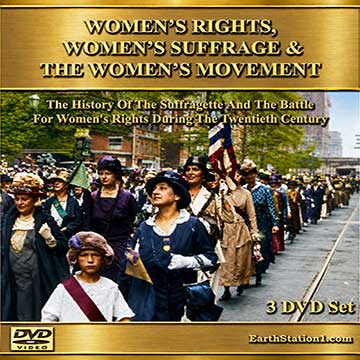
October 23, 1915: Feminism: Women's
Suffrage: Women's Suffrage In The United States: The 1915 Women's
March For Suffrage: -- The largest parade ever held in New York
City at that time occurs when 25,000-33,000 women march on Fifth
Avenue to advocate their right to vote. At that point, the fight
for women's suffrage had been ongoing for more than 65 years. The
New York Times ran an article warning that if women get the vote,
they will "play havoc for themselves and society," and
that "granted the suffrage, they would demand all the rights
that implies. It is not possible to think of women as soldiers and
sailors, police patrolmen, or firemen". In 1917, New York
State granted women the right to vote. It was one of the first
states to do so, and the domino effect lead to the passage of the
19th Amendment in 1920, which granted women the right to vote
across the country. However, that didn't put an end to the
assumptions that women couldn't be soldiers, or firefighters, or
many other things traditionally in the male realm. Women fought,
and continue to fight, for the right to be considered equal
citizens every day, both in America and across the world.
https://store.earthstation1.com/women39s-suffrage-amp-the-women39s-movement-dvd-mp4-usb-39394.html
Today's
EarthStation1.com 15% (Or More!) Off Commemorative Memorial Title:
Funny Business: A Stand Up Life Stand-Up Comedy MP4 Video Download
DVD
Today, October 23, 2026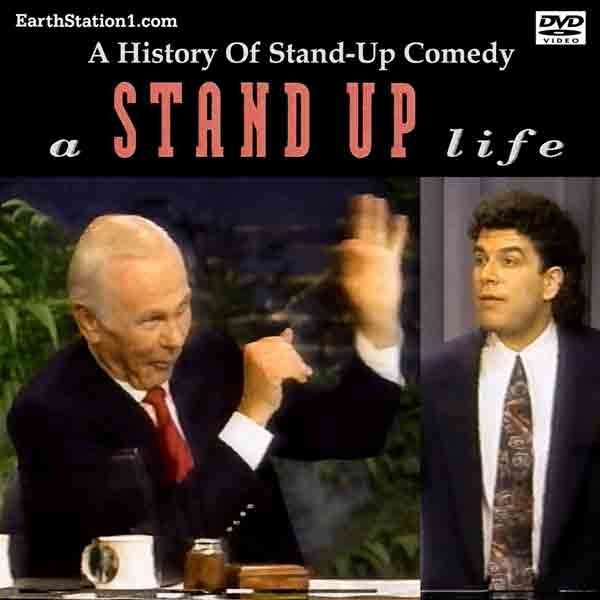
October 23, 1925: #BOTD: #HBD! Johnny Carson, American comedian and talk show host, best known for his 30 years as host of The Tonight Show Starring Johnny Carson (1962-1992) (d. January 23, 2005) is #born John William Carson in Corning, Iowa; in recognition of Carson's birth, October 23 is annually recognized as National TV Talk Show Host Day. Johnny Carson was born John William Carson in Corning, Iowa, to Ruth Elizabeth (Hook) Carson (1901-1985) and Homer Lloyd "Kit" Carson. Carson received six Emmy Awards, the Television Academy's 1980 Governor's Award, and a 1985 Peabody Award. He was inducted into the Television Academy Hall of Fame in 1987. Carson was awarded the Presidential Medal Of Freedom in 1992 and received a Kennedy Center Honor in 1993. Although his show was already successful by the end of the 1960s, it was during the 1970s Carson became an American icon and remained so even after his retirement in 1992. He adopted a casual, conversational approach with extensive interaction with guests, an approach pioneered by Arthur Godfrey and previous Tonight Show hosts Steve Allen and Jack Paar. Carson died aged 79 at Cedars-Sinai Medical Center in Los Angeles of respiratory failure arising from emphysema. His body was cremated, and the ashes were given to his wife, Alexis Maas. In accordance with his family's wishes, no public memorial service was held. Carson was also survived by his younger brother, Dick, who was an Emmy Award-winning director of, among other things, the competing Merv Griffin Show and Wheel of Fortune. Numerous tributes were paid to Carson upon his death, including a statement by then-President George W. Bush, all recognizing the deep and enduring affection held for him. On January 31, The Late Show With David Letterman paid tribute with former Tonight Show executive producer Peter Lassally and bandleader Doc Severinsen. At the beginning of this show, Letterman said that for 30 years, no matter what was going on in the world, whether people had a good or bad day, they wanted to end it being "tucked in by Johnny." He also told his viewers that the monologue he had just spoken, which was very well received by the studio audience, consisted entirely of jokes sent to him by Carson in the last few months of his life. Doc Severinsen ended the Letterman show that night by conducting and playing, along with Tommy Newsom and Ed Shaughnessy. The Tonight Show with Jay Leno also paid tribute to Carson with guests Ed McMahon, Bob Newhart, Don Rickles, Drew Carey, and k.d. lang. On his final Tonight Show appearance, Carson himself said that while sometimes people who work together for long stretches of time on television do not necessarily like each other, this was not the case with McMahon; he and McMahon were good friends who would have drinks and dinner together, and the camaraderie they had on the show could not be faked. Their friendship spanned 46 years. https://store.earthstation1.com/fubustlistco.html
Today's
EarthStation1.com 15% (Or More!) Off Commemorative Memorial Title:
The Wall Street Crash Of 1929 Documentary Set MP4 Video Download
DVD
Today, October 23, 2026
October 23, 1929: Economics: Markets (Economics): Financial Markets: Exchanges (Bourses, Trading Exchanges, Trading Venues): Stock Exchanges (Securities Exchanges, Bourses): Stock Markets (Equity Markets, Share Markets): Financial Crises: Financial Crises In The United States: Stock Market Crashes: Stock Market Crashes In The United States: Economic Crises: Economic Crises In The United States: Financial Markets Of The United States ("Wall Street"): The New York Stock Exchange (NYSE, The Big Board): The Wall Street Crash Of 1929 (The Wall Street Crash, The Great Crash, The Crash of '29): -- After a steady decline in stock market prices since a peak in September, the New York Stock Exchange begins to crash, crashing outright the following day (Black Thursday) until the crash's climax on October 29 (Black Tuesday). The Wall Street Crash Of 1929 started in September of that year, when share prices on the New York Stock Exchange (NYSE) collapsed, and ended in mid-November. The pivotal role of the 1920s' high-flying bull market and the subsequent catastrophic collapse of the NYSE in late 1929 is often highlighted in explanations of the causes of the worldwide Great Depression. It was the most devastating stock market crash in the history of the United States when taking into consideration the full extent and duration of its aftereffects. The Great Crash is mostly associated with October 24, 1929, called Black Thursday, the day of the largest sell-off of shares in U.S. history, and October 29, 1929, called Black Tuesday, when investors traded some 16 million shares on the New York Stock Exchange in a single day.The crash, which followed the London Stock Exchange's crash of September, signaled the beginning of the Great Depression (1929-1939). https://store.earthstation1.com/wastcrof19do.html
Today's
EarthStation1.com 15% (Or More!) Off Commemorative Memorial Title:
Perspective On Greatness: Cops Vs Robbers DVD, Download, USB Drive
Today, October 23, 2026
October 23, 1935: Crime: Organized Crime:
Organized Crime In The United States: The Noe-Schultz Gang: The
Chophouse Massacre: -- Dutch Schultz, Abe Landau, Otto Berman, and
Bernard "Lulu" Rosencrantz are fatally shot at Schultz's
headquarters, the Palace Chophouse saloon and restaurant in
Newark, New Jersey. Dutch Schultz died the next day. Schultz' last
words were a strange stream-of-consciousness babble, spoken in his
hospital bed to police officers who attempted to calm him and
question him for useful information. Although the police were
unable to extract anything coherent from Schultz, his rambling was
fully transcribed by a police stenographer. This includes the
famous: "A boy has never wept...nor dashed a thousand kim."
But the entire text (linked below) is much more rambling, for
example: "You can play jacks, and girls do that with a soft
ball and do tricks with it.". Oh, Oh, dog Biscuit, and when
he is happy he doesn't get snappy. One of his last utterances was
a reference to "French Canadian bean soup" (French
Canadian pea soup is a popular dish that is still produced as
canned goods by many food companies). Schultz' last words inspired
a number of writers to devote works related to them. Beat
Generation author William S. Burroughs published a screenplay in
novel form titled The Last Words of Dutch Schultz in the early
1970s, while Robert Shea and Robert Anton Wilson connected
Schultz' words to a global Illuminati-related conspiracy, making
them a major part of 1975' The Illuminatus! Trilogy. (In Wilson'
and Shea' story, Schultz' ramblings are a coded message.) In his
1960 anthology Parodies, Dwight Macdonald presents Schultz' last
words as a parody of Gertrude Stein. In the novel Billy Bathgate,
the protagonist used clues from Schultz' deathbed ramblings to
locate his hidden money. Several actors have played Dutch Schultz
in films: Vic Morrow in Portrait of a Mobster (1960), Vincent
Gardenia in Mad Dog Coll (1961), James Remar in The Cotton Club
(1984), Dustin Hoffman in Billy Bathgate (1991), Bruce Nozick in
Hit the Dutchman (1992), Lance Henriksen in The Outfit (1993), and
Tim Roth in Hoodlum (1997). In the 1959 The Untouchables episode
"The Dutch Schultz Story", Schultz was played by
Lawrence Dobkin. The building that housed the Palace Chop House
was torn down in 2008.
https://store.earthstation1.com/perspective-on-greatness-cops-and-robbers-dvd.html
Today's
EarthStation1.com 15% (Or More!) Off Commemorative Memorial Title:
Francisco Franco Documentary Set Spanish Civil War MP4 Download
DVD
Today, October 23, 2026
October 23, 1940: The European Civil War:
World War II: The Second European War (The European Theater Of
World War II): The Meeting Of Hendaye (The Interview Of Hendaye):
-- Adolf Hitler, Fuehrer (Leader) of Nazi Germany, and Francisco
Franco, Caudillo (Leader) of Francoist Spain, meet at the railway
station in Hendaye, France, near the Spanish-French border, to
discuss the possibility of Spain entering the Second World War.
The meeting was also attended by the respective foreign ministers,
Ramon Serrano Suner of Spain and Joachim Von Ribbentrop of
Germany. The object of the meeting was to attempt to resolve
disagreements over the conditions for Spain to join the Axis
Powers in their war against the British Empire. However, after
seven hours of talks, the Spanish demands still appeared
extortionate to Hitler: the handing over of Gibraltar once the
British were defeated; the cession of French Morocco and part of
French Algeria; the attachment of French Cameroon to the Spanish
colony of Guinea; and German supplies of food, petrol and arms to
relieve the critical economic and military situation faced by
Spain after the Spanish Civil War. Hitler did not wish to disturb
his relations with the Vichy French regime. The only concrete
result was the signing of a secret agreement under which Franco
was committed to entering the war at a date of his own choosing,
and Hitler gave only vague guarantees that Spain would receive
"territories in Africa". A few days later in Germany,
Hitler famously told Benito Mussolini, "I prefer to have
three or four of my own teeth pulled out than to speak to that man
again!" It is subject to historical debate whether Franco
overplayed his hand by demanding too much from Hitler for Spanish
entry into the war, or if he deliberately demanded too much to
avoid joining the war.
https://store.earthstation1.com/francisco-franco-dvd-general-caudillo-spanish-civil-war.html
Today's
EarthStation1.com 15% (Or More!) Off Commemorative Memorial Title:
Clive James' Fame In The 20th Century TV Series DVD Set MP4 USB
Drive
Today, October 23, 2026
October 23, 1940: #BOTD: #HBD! Pele,
Black Brazilian soccer player (footballer) who played forward, and
actor, regarded as one of the greatest football players of all
time, and labelled "the greatest" by FIFA, among the
most successful and popular sports figures of the 20th century (d.
December 29, 2022) is #born Edson Arantes do Nascimento in Tres
Coracoes, Minas Gerais, Brazil. In 1999, he was named Athlete of
the Century by the International Olympic Committee and was
included in the Time list of the 100 most important people of the
20th century. In 2000, Pele was voted World Player of the Century
by the International Federation of Football History &
Statistics (IFFHS), and was one of the two joint winners of the
FIFA Player of the Century. His 1,279 goals in 1,363 games, which
includes friendlies, is recognised as a Guinness World Record.
Pele began playing for Santos at age 15 and the Brazil national
team at 16. During his international career, he won three FIFA
World Cups: 1958, 1962 and 1970, the only player to do so. Pele is
the all-time leading goalscorer for Brazil with 77 goals in 92
games. At club level he is Santos' all-time top goalscorer with
643 goals from 659 games. In a golden era for Santos, he led the
club to the 1962 and 1963 Copa Libertadores, and to the 1962 and
1963 Intercontinental Cup. Credited with connecting the phrase
"The Beautiful Game" with football, Pele's "electrifying
play and penchant for spectacular goals" made him a star
around the world, and his teams toured internationally in order to
take full advantage of his popularity. During his playing days,
Pele was for a period the best-paid athlete in the world. Since
retiring in 1977, Pele has been a worldwide ambassador for
football and has made many acting and commercial ventures. In
2010, he was named the Honorary President of the New York Cosmos.
Averaging almost a goal per game throughout his career, Pele was
adept at striking the ball with either foot in addition to
anticipating his opponents' movements on the field. While
predominantly a striker, he could also drop deep and take on a
playmaking role, providing assists with his vision and passing
ability, and he would also use his dribbling skills to go past
opponents. In Brazil, he is hailed as a national hero for his
accomplishments in football and for his outspoken support of
policies that improve the social conditions of the poor. His
emergence at the 1958 World Cup where he became the first black
global sporting star was a source of inspiration. Throughout his
career and in his retirement, Pele received several individual and
team awards for his performance in the field, his record-breaking
achievements, and legacy in the sport. Pele died at 3:27 pm at The
Albert Einstein Israelite Hospital in Sao Paulo, Brazil of
multiple organ failure, a complication of colon cancer aggravated
by COVID-19, at the age of 82. Pele's death certificate stated
that he had died of kidney failure, heart failure,
bronchopneumonia and colon adenocarcinoma. He was survived by his
100-year-old mother, Celeste, who, given her advanced age, did not
understand her son's death; Pele's sister Maria Lucia do
Nascimento described their mother as "in her own little
world". Respects were paid by the great and the good
throughout the world, and after a long and elaborate funeral
procession, Pele was buried at the Memorial Necropole Ecumenica in
Sao Paulo.
https://store.earthstation1.com/clive-james39-fame-in-the-20th-century-tv-series-dvd-set-mp4-usb-39204.html
Today's
EarthStation1.com 15% (Or More!) Off Commemorative Memorial Title:
Georgy Zhukov Marshal Of The Soviet Union MP4 Video Download DVD
Today, October 23, 2026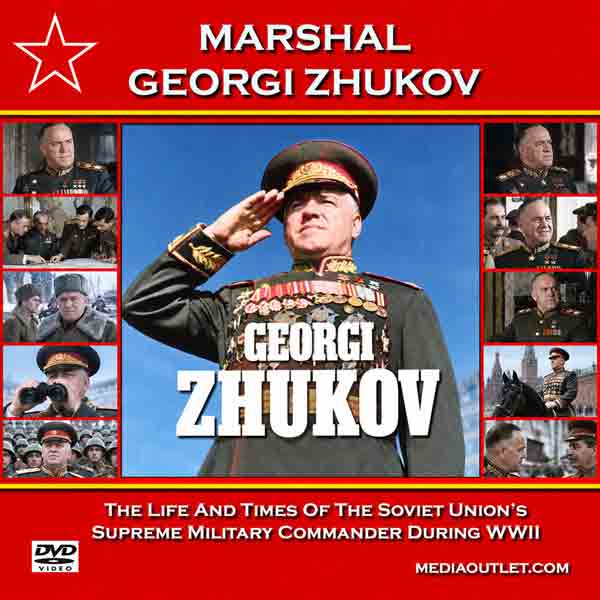
October 23, 1941: The European Civil War:
World War II: The Second European War (The European Theater Of
World War II): The Eastern Front Of World War II: The Great
Patriotic War (The German-Soviet War): -- Soviet Field Marshal
Georgy Zhukov takes command of Red Army operations to prevent the
further advance into Russia of German forces and to prevent the
Wehrmacht from capturing Moscow. Georgy Konstantinovich Zhukov
(December 1 [O.S. November 19] 1896: June 18, 1974) was a career
Russian officer in the Red Army of the Soviet Union who became
Chief of General Staff, Deputy Commander-In-Chief, Minister of
Defence and a member of the Politburo. During World War II he
participated in multiple battles, ultimately commanding the 1st
Belorussian Front in the Battle of Berlin. In recognition of
Zhukov's role in World War II, he was allowed to participate in
signing the German Instrument of Surrender and to inspect the
Moscow Victory Parade of 1945. He later fell out of favor with
Stalin, but after his death in 1953 his star rose again, having
arrested Beria and found the favor of Nikita Khrushchev and
Nikolai Bulganin. Until 1955, Zhukov had both sent and received
letters from Eisenhower. Both leaders agreed that the two
superpowers should coexist peacefully. He was forcibly retired
from governmental service in 1957, but again brought back into
favor if not government by Brezhnev. His memoirs were published in
1969 and became a best-seller.
https://store.earthstation1.com/zhukov-dvd-marshal-georgi-soviet-union-wwii.html
Today's
EarthStation1.com 15% (Or More!) Off Commemorative Memorial Title:
Monty: Bernard Montgomery Documentaries DVD, Video Download, USB
Drive
Today, October 23, 2026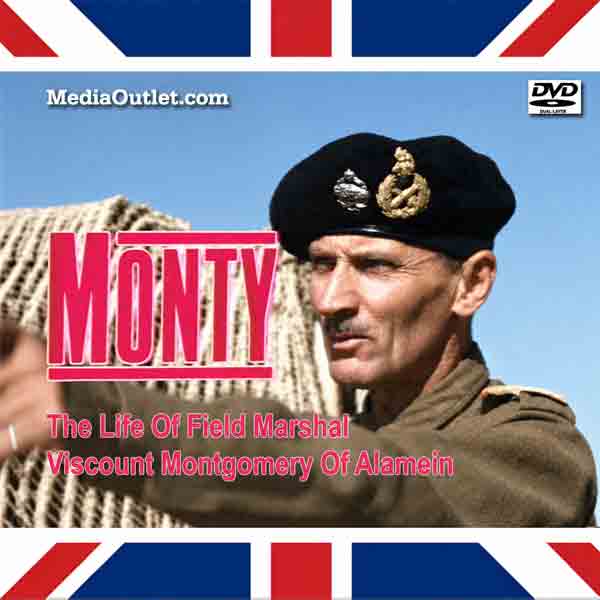
October 23, 1942: The European Civil War:
World War II: The Second European War (The European Theater Of
World War II): The North African Campaign: The Western Desert
Campaign (The Desert War): The Battles Of El Alamein: The Second
Battle Of El Alamein -- The British Eighth Army under Field
Marshal Montgomery begins a critical offensive near the Egyptian
railway halt of El Alamein, a town in the northern Matrouh
Governorate of northern Egypt, to expel the Axis armies from
Egypt, beginning The Second Battle Of El Alamein (October 23 -
November 11, 1942). The First Battle Of El Alamein and the Battle
Of Alam El Halfa had prevented the Axis from advancing further
into Egypt. In August 1942, General Claude Auchinleck had been
relieved as Commander-In-Chief Middle East Command, and his
successor, Lieutenant-General William Gott was killed on his way
to replace him as commander of the Eighth Army. Lieutenant-General
Bernard Montgomery was hastily appointed in the aftermath of
Gott's death, and he led the Eighth Army offensive. The ultimate
Allied victory was the beginning of the end of the Western Desert
Campaign, eliminating the Axis threat to Egypt, the Suez Canal and
the Middle Eastern and Persian oil fields. The battle revived the
morale of the Allies, being the first big success against the Axis
since Operation Crusader in late 1941. The battle coincided with
the Allied invasion of French North Africa in Operation Torch on
November 8, the Battle Of Stalingrad and the Guadalcanal Campaign.
https://store.earthstation1.com/montgomery-dvd-field-marshal-bernard-law-dual-layer-wwii.html
Today's
EarthStation1.com 15% (Or More!) Off Commemorative Memorial Title:
The Battle Of Leyte Gulf DVD, MP4 Video Download, USB Flash Drive
Today, October 23, 2026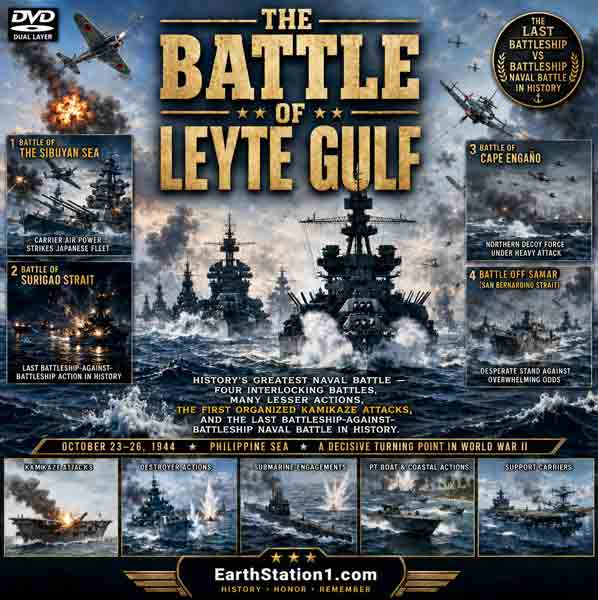
October 23-26, 1944: World War II: The
Pacific War (The Asia-Pacific War, The Asiatic-Pacific Theater,
The Pacific Theater Of World War II): The Pacific Ocean Theater Of
World War II: The Southwest Pacific Theater Of World War II: The
Philippines Campaign (1944-1945) (Battle Of The Philippines,
Second Philippines Campaign, The Liberation Of The Philippines,
Operation Musketeer I, II, and III): The Battle Of Leyte Gulf --
The largest naval battle in history begins off the coasts of the
Philippine Islands, beginning The Battle Of Leyte Gulf (October
23-26, 1944). The battle involved 216 U.S. warships and 64
Japanese ships and resulted in the destruction of the Japanese
Navy including the Japanese Battleship Musashi, one of the largest
ever built. It was fought in waters near the Philippine islands of
Leyte, Samar and Luzon, from October 23-26, 1944, between combined
American and Australian forces and the Imperial Japanese Navy. On
20 October, United States troops invaded the island of Leyte as
part of a strategy aimed at isolating Japan from the countries it
had occupied in Southeast Asia, and in particular depriving
Japanese forces and industry of vital oil supplies. The Imperial
Japanese Navy (IJN) mobilized nearly all of its remaining major
naval vessels in an attempt to defeat the Allied invasion but was
repulsed by the U.S. Navy's Third and Seventh Fleets. The IJN
failed to achieve its objective, suffered heavy losses, and never
sailed to battle in comparable force thereafter. The majority of
its surviving heavy ships, deprived of fuel, remained in their
bases for the rest of the Pacific War and suffered under heavy
sustained aerial attack. The battle consisted of several separate
engagements between the opposing forces: The Battle Of The Sibuyan
Sea, The Battle Of Surigao Strait, The Battle Of Cape Engano and
The Battle Off Samar, as well as other actions. This was the first
battle in which Japanese aircraft carried out organized kamikaze
attacks. By the time of the battle, Japan had fewer naval ships
than the Allied forces had aircraft carriers, underscoring the
disparity in force strength at this point in the war.
https://store.earthstation1.com/the-battle-of-leyte-gulf-dvd-mp4-download-usb-flash-driv4.html
Today's
EarthStation1.com 15% (Or More!) Off Commemorative Memorial Title:
Vietnam: The Ten Thousand Day War TV Series DVD, Video Download,
USB
Today, October 23, 2026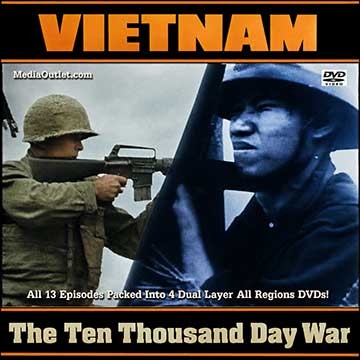
October 23, 1955: The Aftermath Of World
War II: The Cold War: The Cold War (1953-1962): The Cold War In
Asia: The State Of Vietnam: The 1955 State Of Vietnam Referendum:
-- The Republic Of Vietnam (RVN; Vietnamese: Viet Nam Cong Hoa;
French: Republique Du Viet Nam), colloquially known as South
Vietnam, is founded when The State Of Vietnam Prime Minister Ngo
Dinh Diem defeats former emperor Bao Dai in blatantly fraud-ridden
referendum vote. The 1955 State Of Vietnam Referendum determined
the future form of government of the State Of Vietnam. Though
published counts showed Diem winning the election with 98.9% of
the vote, the referendum was widely marred by electoral fraud. In
the capital, Saigon, Diem was credited with more than 600,000
votes, although only 450,000 people were on the electoral roll,
while Diem was also credited with receiving over 90% of registered
voters in rural regions where opposition groups had prevented
voting. The referendum was the last phase in the power struggle
between Bao Dai and his prime minister. Bao Dai disliked Diem and
had frequently attempted to undermine him, having appointed him
only because he was a conduit to American aid. At the time, the
country was going through a period of insecurity, as Vietnam had
been temporarily partitioned as a result of the 1954 Geneva
Accords that ended the First Indochina War. The State of Vietnam
controlled the southern half of the country, pending national
elections that were intended to reunify the country under a common
government. Still, the Vietnamese National Army was not in full
control of southern Vietnam; the Cao Dai and Hoa Hao religious
sects ran their own administrations in the countryside supported
by private armies, while the Binh Xuyen organised crime syndicate
controlled the streets of Saigon. Despite interference from these
groups, Bao Dai, and even French officials, Diem managed to subdue
the private armies and consolidate government control over the
country by mid-1955. Emboldened by his success, Diem began to plot
Bao Dai's downfall. He scheduled a referendum for October 23, 1955
and pushed Bao Dai out of the political scene, hindering the
former emperor's attempts to derail the poll. In the period
leading up to the vote, campaigning for Bao Dai was banned, while
Diem's election campaign focused on personal attacks against Bao
Dai. These included pornographic cartoons of the head of state and
unverified rumours claiming he was illegitimate and linking him to
various mistresses. The government-controlled media launched
polemical attacks on Bao Dai, and police went door-to-door,
warning people of the consequences of failing to vote. After his
brother Ngo Dinh Nhu had rigged the referendum, Diem proclaimed
himself president of the newly created Republic of Vietnam.
https://store.earthstation1.com/vietnam-the-10000-day-war-4-dual-layer-dvds-all-13-10000413.html
Today's
EarthStation1.com 15% (Or More!) Off Commemorative Memorial Title:
Chopper Wars: Airmobile Helicopters & The Vietnam War DVD,
MP4, USB
Today, October 23, 2026
October 23, 1965: The Aftermath Of World
War II: The Cold War: The Cold War In Asia: The Indochina Wars:
The Vietnam War (The Second Indochina War, The Vietnam Conflict,
The Resistance War Against America): The United States In The
Vietnam War: The Siege Of Plei Me -- The initial phase of the
first major confrontation between soldiers of the North Vietnamese
People's Army Of Vietnam (PAVN) and the U.S. Army begins when the
1st Cavalry Division (Airmobile), in conjunction with South
Vietnamese forces, launch an operation seeking to destroy
Communist forces besieging the United States Army Special Forces
camp of Plei Me, 25 miles south of Pleiku city and less than 20
miles from the Cambodian border in the Central Highlands of South
Vietnam. The lifting of the siege by South Vietnamese forces and
American air power was followed by the pursuit of the retreating
North Vietnamese from October 28 until November 12, setting the
stage for the Battle Of Ia Drang, the final and climactic phase of
this first major PAVN/USA confrontation of what became known as
The Pleiku Campaign (The Pleime Campaign), notable for being the
first large scale helicopter air assault, and also the first use
of Boeing B-52 Stratofortress strategic bombers in a tactical
support role. Ia Drang set the blueprint for the Vietnam War with
the Americans relying on air mobility, artillery fire and close
air support, while the PAVN neutralized that firepower by quickly
engaging American forces at very close range.
https://store.earthstation1.com/chopper-wars-vietnam-war-amp-airmobile-helicopters-dvd-mp4-us4.html
Today's
EarthStation1.com 15% (Or More!) Off Commemorative Memorial Title:
The Sword Of Islam: The Islamic Revolution DVD MP4 USB Flash Drive
Today, October 23, 2026
October 23, 1983: 1983: The Aftermath Of
World War II: The Cold War: The Cold War (1979-1985): The
Decolonization Of Asia: The Arab-Israeli Conflict: The
Israeli-Palestinian Conflict: The Iran-Israel Proxy Conflict: The
Arab Cold War: The Lebanese Civil War: The 1983 Beirut Barracks
Bombings: -- Two truck bombs strike buildings in Beirut, Lebanon:
one truck bomb strking a barracks housing American forces, and the
other truck striking a barracks housing French forces, both forces
serving as members of the Multinational Force in Lebanon (MNF), a
military peacekeeping operation during the Lebanese Civil War. The
1983 Beirut Barracks Bombings attack killed 307 people: 241 U.S.
and 58 French military personnel, six civilians, and two
attackers. The first suicide bomber detonated a truck bomb at the
building serving as a barracks for the 1st Battalion 8th Marines
(Battalion Landing Team - BLT 1/8) of the 2nd Marine Division,
killing 220 Marines, 18 sailors and 3 soldiers, making this
incident the deadliest single-day death toll for the United States
Marine Corps since the Battle Of Iwo Jima in World War II and the
deadliest single-day death toll for the United States Armed Forces
since the first day of the Tet Offensive in the Vietnam War.
Another 128 Americans were wounded in the blast; 13 later died of
their injuries, and they are counted among the number who died. An
elderly Lebanese man, a custodian/vendor who was known to work and
sleep in his concession stand next to the building, was also
killed in the first blast. The explosives used were later
estimated to be equivalent to as much as 9,500 kg (21,000 pounds)
of TNT. Minutes later, a second suicide bomber struck the
nine-story Drakkar building, a few kilometers away, where the
French contingent was stationed; 55 paratroopers from the 1st
Parachute Chasseur Regiment and three paratroopers of the 9th
Parachute Chasseur Regiment were killed and 15 injured. It was the
single worst French military loss since the end of the Algerian
War. The wife and four children of a Lebanese janitor at the
French building were also killed, and more than twenty other
Lebanese civilians were injured. A group called Islamic Jihad
claimed responsibility for the bombings and said that the aim was
to force the MNF out of Lebanon. According to Caspar Weinberger,
then United States Secretary Of Defense, there is no knowledge of
who did the bombing. Some analysis highlights the role of
Hezbollah and Iran, calling it "an Iranian operation from top
to bottom". There is no consensus on whether Hezbollah
existed at the time of bombing. The attacks eventually led to the
withdrawal of the international peacekeeping force from Lebanon,
where they had been stationed following the Palestine Liberation
Organization (PLO) withdrawal in the aftermath of Israel's 1982
invasion of Lebanon. In 2004 it was reported that an Iranian group
called the Committee for the Commemoration of Martyrs of the
Global Islamic Campaign had erected a monument, at the
Behesht-e-Zahra cemetery in Tehran, to commemorate the 1983
bombings and its "martyrs".
https://store.earthstation1.com/the-sword-of-islam-the-islamic-revolution-dvd-mp4-usb-flash-driv4.html
Today's
EarthStation1.com 15% (Or More!) Off Commemorative Memorial Title:
Gorbachev: The Rise And Fall + Oleg Gordievsky Doc MP4 Download
DVD
Today, October 23, 2026
October 23, 1989: The Aftermath Of World
War II: The Cold War: The Cold War (1985-1991) (The End Of The
Cold War): The Dissolution Of The Soviet Union: The Revolutions Of
1989 (The Fall Of Nations, The Autumn Of Nations, The Fall Of
Communism): The Eastern Bloc (The Communist Bloc, The Socialist
Bloc, The Soviet Bloc): Rendszervaltas (Hungarian: "Regime
Change", "System Change") (The 1989 End Of
Communism In Hungary): -- As the Soviet Union weakens at the end
of the 1980s and the Eastern bloc disintegrates, communist rule in
the People's Republic of Hungary comes to an end by a peaceful
transition to a democratic regime as Hungary declares itself a
republic on the 33 year anniversary of Soviet Russian troops
crushed a popular revolt against Communist rule.
https://store.earthstation1.com/gorbachev-the-rise-and-fall-dvd-mp4-usb-flash-driv4.html
Today's
EarthStation1.com 15% (Or More!) Off Commemorative Memorial Title:
Pirates 12 Part Documentary Series MP4 Video Download DVD
Today, October 23, 2026
October 23, 1739: Crime: Organized Crime:
Piracy: The History Of Piracy: The Golden Age Of Piracy
(1650s-1730s): The French-Habsburg Rivalry: The Austro-Prussian
Rivalry: The War Of The Austrian Succession: The War Of Jenkins'
Ear: -- The War Of Jenkins' Ear (October 22, 1739 - October 18,
1748) begins when Sir Robert Walpole, 1st Earl of Orford, British
Whig statesman who in his capacity as the de facto first Prime
Minister of Great Britain, reluctantly declares war on Spain in
accordance with the day's formal ratification by Parliament of
King George II's June 15 war declaration. The War Of Jenkins' Ear
between the Kingdom of Great Britain and the Kingdom of Spain
occurred on April 9 (Jenkins' Ear Day [Spain]), 1731 when Spanish
coast guards led by privateer Juan de Leon Fandino invaded,
searched, and raided the British smuggling brig Rebecca, commanded
by British privateer Captain Robert Jenkins. Returning home from a
trading voyage in the West Indies in command of the smuggling brig
Rebecca in April 1731, Jenkins' ship was stopped and boarded by
the Spanish guarda-costa or privateer La Isabela on suspicion of
smuggling. According to some accounts, her commander, Juan de Leon
Fandino, had Jenkins bound to a mast, then sliced off his left ear
with his sword and allegedly told him to say to his King "the
same will happen to him (the king) if caught doing the same".
On arriving in Britain on June 11, Jenkins addressed his
grievances to the king, and gave a deposition which was passed to
the Duke of Newcastle in his capacity as Secretary of State for
the Southern Department (as such responsible for the American
colonies). In his deposition of June 18, 1731, which was reported
in the Pennsylvania Gazette for October 7 1731, Jenkins stated
that the Spanish captain (in Pennsylvania Gazette, it referred to
Spanish lieutenant Dorce instead) "took hold of his left Ear
and with his Cutlass slit it down, and then another of the
Spaniards took hold of it and tore it off, but gave him the Piece
of his Ear again." This report was then forwarded to the
Commander-In-Chief in the West Indies, who then complained of
Jenkins' treatment to the Governor of Havana. The exact reason why
the Spanish privateers chopped off his ear is unclear. Some
accounts say it was a punishment for raiding Spanish ships, while
others say Rebecca was carrying contraband. There is no evidence
corroborating the oft-repeated story that in spring 1738 Jenkins
told his story with dramatic details before a committee of the
House of Commons, producing his severed ear (pickled in a jar).
According to this story, Jenkins returned to England with his
pickled ear in a bottle, which had a tremendous effect on the
nation. So much so that The House of Commons summoned him in March
1738 to appear before them and produce the severed ear. Jenkins
dutifully did so to the astonishment of the House. Those in
attendance asked him what he had done to warrant such treatment.
To this, Jenkins replied, "I commended my soul to God and my
cause to my country." This story stirred up the country's
imagination. The power of this shriveled object was immense and
the ear became a symbol of English pride. To this extent, the ear
started a war between England and Spain in 1739. Consequently, the
war is known as the War Of Jenkins' Ear which occurred in several
waves. There were several diplomatic negotiation attempts between
England and Spain throughout the 1730s in Europe and America.
However, these only heightened the animosity between the two
nations, leading to the War Of Jenkins' Ear in late 1739. The
Royal Naval commander in Port Royal said that people involved in
what he described as "clandestine trade" had no right to
complain if their cargoes were confiscated and often indulged in
violence. After all, such incidents were seen as normal at the
time - the cost of doing business. The English people were enraged
by the incident and demanded that the Spanish be taught a lesson.
Cutting off Englishmen's ears was unacceptable! The British
launched attacks on Spanish possessions in Central America,
resulting in high casualties mainly from disease. After 1742, this
war was overtaken by the wider War of the Austrian Succession, in
which most of the powers of Europe took part. Peace was only
restored with the Treaty of Aix-la-Chapelle in 1748.
Traditionally, the main cause of the War Of Jenkins' Ear has been
stated as a dispute between Spain and Britain over access to
markets in Spanish America. However, in recent times, historians
such as Woodfine and Anderson argue that this was only one of many
issues. The other reasons include tensions with Spain over
colonial expansion in North America and French concern at the
growth in British commercial strength from 1714.
https://store.earthstation1.com/pirates-12-part-documentary-series-mp4-video-download-124.html
Today's
EarthStation1.com 15% (Or More!) Off Commemorative Memorial Title:
The Battle Of Guadalcanal DVD MP4 Download USB Flash Drive
Today, October 23, 2026
October 23, 1942: World War II: The
Pacific War (The Asia-Pacific War, The Asiatic-Pacific Theater,
The Pacific Theater Of World War II): The Pacific Ocean Theater Of
World War II: The South West Pacific Area (SWPA): Operation
Cartwheel: The Solomon Islands Campaign: The Battle Of Guadalcanal
(The Guadalcanal Campaign, Operation Watchtower): The Battle For
Henderson Field (Japanese: The Battle Of Guadalcanal, The Battle
Of Lunga Point): -- U.S. Marine and Army forces, under the overall
command of Major General Alexander Vandegrift, repulses an attack
along the Lunga perimeter by the Japanese 17th Army, under the
command of Japanese Lieutenant General Harukichi Hyakutake, to
retake Henderson Field, which had been captured from the Japanese
by the Allies in landings on Guadalcanal on August 7, 1942, an
airfield built by the Japanese on Lunga Point and named Lunga
Point Airfield (Runga Point Airfield). The airfield was intended
to allow Japanese aircraft to patrol the southern Solomons,
shipping lanes to Australia, and the eastern flank of New Guinea.
The Japanese completed the airfield on August 6; the Americans
invaded the next day. General Hyakutake's force was sent to
Guadalcanal in response to these Allied landings with the mission
of recapturing the airfield and driving the Allied forces off the
island, the third and last of the three major land offensives
conducted by the Japanese during the Guadalcanal campaign.
Hyakutake's soldiers conducted numerous assaults over three days
at various locations around the Lunga perimeter, all repulsed with
heavy Japanese losses. At the same time, Allied aircraft operating
from Henderson Field successfully defended U.S. positions on
Guadalcanal from attacks by Japanese naval air and sea forces. The
battle was the last serious ground offensive conducted by Japanese
forces on Guadalcanal. After an attempt to deliver further
reinforcements failed during the Naval Battle Of Guadalcanal in
November 1942, Japan conceded defeat in the struggle for the
island and evacuated many of its remaining forces by the first
week of February 1943.
https://store.earthstation1.com/the-battle-of-guadalcanal-dvd-mp4-download-usb-flash-driv4.html
Today's
EarthStation1.com 15% (Or More!) Off Commemorative Memorial Title:
Battleline (1963) WWII TV Documentary Series DVD, Download, USB
Drive
Today, October 23, 2026
October 23, 1944: World War II: The
Pacific War (The Asia-Pacific War, The Asiatic-Pacific Theater,
The Pacific Theater Of World War II): The Pacific Ocean Theater Of
World War II: The Southwest Pacific Theater Of World War II: The
Philippines Campaign (1944-1945) (Battle Of The Philippines,
Second Philippines Campaign, The Liberation Of The Philippines,
Operation Musketeer I, II, and III): The Battle Of Leyte
(Codename: King Two; Filipino: Labanan Sa Leyte; Waray: Gubat Ha
Leyte; Japanese: Reite No Tatakai) -- General MacArthur presides
over a ceremony to restore civil government to Leyte. 1st and 2nd
Cavalry Brigades initiated a holding action to prevent a Japanese
counterattack from the mountainous interior, after which the 1st
Cavalry was allowed to move on. The Battle Of Leyte (Filipino:
Labanan Sa Leyte; Waray: Gubat Ha Leyte; Japanese: Reite No
Tatakai) in the Pacific campaign of World War II was the
amphibious invasion of the island of Leyte in the Philippines by
American Army, Navy and Army Air forces and Filipino guerrillas
under the overall command of General Douglas MacArthur, who fought
against the Imperial Japanese Army in the Philippines led by
General Tomoyuki Yamashita. The operation, codenamed King Two,
launched the Philippines campaign of 1944-45 for the recapture and
liberation of the entire Philippine Archipelago and to end almost
three years of Japanese occupation.
https://store.earthstation1.com/battleline-wwii-tv-documentary-series-5-dual-layer-dvd5.html
Today's
EarthStation1.com 15% (Or More!) Off Commemorative Memorial Title:
Air War In Vietnam: Aerial Combat Roles & Missions DVD,
Download, USB
Today, October 23, 2026
October 23, 1972: The Aftermath Of World
War II: The Cold War: The Cold War In Asia: The Indochina Wars:
The Vietnam War (The Second Indochina War, The Vietnam Conflict,
The Resistance War Against America): The United States In The
Vietnam War: Aerial Operations And Battles Of The Vietnam War:
Strategic Bombing During The Vietnam War: Operation Linebacker: --
The US bombing campaign against North Vietnam in response to its
Easter Offensive, Operation Linebacker, ends after five months.
Operation Linebacker was the codename of a U.S. Seventh Air Force
and U.S. Navy Task Force 77 air interdiction campaign conducted
against the North Vietnam from May 9 to October 23, 1972, during
the Vietnam War. The Seventh Air Force (Air Forces Korea) (7 AF)
was and remains a Numbered Air Force of the United States Pacific
Air Forces (PACAF). headquartered at Osan Air Base, South Korea,
and Task Force 77 was the aircraft carrier battle/strike force of
the United States Seventh Fleet in the United States Navy (USN)
since the U.S. Seventh Fleet was formed. Its purpose was to halt
or slow the transportation of supplies and materials for the
Nguyen Hue Offensive (known in the West as the Easter Offensive),
an invasion of the South Vietnam by forces of The People's Army Of
Vietnam (PAVN) that had been launched on March 30. Linebacker was
the first continuous bombing effort conducted against North
Vietnam since the end of Operation Rolling Thunder in November
1968. The aircraft used were McDonnell Douglas F-4 Phantom IIs,
LTV A-7 Corsair IIs, Grumman A-6 Intruders, Vought F-8 Crusaders,
Douglas A-4 Skyhawks, Douglas A-1 Skyraiders, Sikorsky CH-53 Sea
Stallions, Republic F-105 Thunderchiefs and Boeing B-52
Stratofortresses.
https://store.earthstation1.com/air-war-in-vietnam-dvd-aircraft-roles-history1.html
Today's
EarthStation1.com 15% (Or More!) Off Commemorative Memorial Title:
The Missing Tapes: Marty Brill Watergate Comedy LP CD MP3 Download
USB
Today, October 23, 2026
October 23, 1973: Scandals: Political
Scandals: Political Scandals Of The United States: Richard Nixon:
The Presidency Of Richard Nixon: The Watergate Scandal: The Nixon
White House Tapes: -- Four days after President Richard Nixon
rejected an Appeals Court decision that he turn over the Nixon
White House Tapes relevant to the Watergate Scandal, President
Nixon at last agrees to turn over subpoenaed audio tapes of his
Oval Office conversations. On July 16, 1973, White House aide
Alexander Butterfield had told the Senate Watergate Committee in a
televised hearing that Nixon had ordered a taping system installed
in the White House to automatically record all conversations.
Special Counsel Archibald Cox, a former United States Solicitor
General under President John F. Kennedy, asked District Court
Judge John Sirica to subpoena nine relevant tapes to confirm the
testimony of White House Counsel John Dean. President Nixon
initially refused to release the tapes, for two reasons: first,
that the Constitutional principle of executive privilege extends
to the tapes and citing the separation of powers and checks and
balances within the Constitution, and second, claiming they were
vital to national security. On October 19, 1973, he offered a
compromise; Nixon proposed that U.S. Senator John C. Stennis
review and summarize the tapes for accuracy and report his
findings to the special prosecutor's office. Special prosecutor
Archibald Cox refused the compromise and on Saturday, October 20,
1973, Nixon ordered Attorney General Elliot Richardson to dismiss
Cox. Richardson refused and resigned instead, then Deputy Attorney
General William Ruckelshaus was asked to dismiss Cox but refused
and was subsequently fired. Solicitor General and acting head of
the Justice Department Robert Bork discharged Cox. These repeated
attempts by Nixon to fire Cox became known as the Saturday Night
Massacre.
https://store.earthstation1.com/the-missing-tapes-starring-marty-brill-watergate-comedy-mp3-c3.html
Today's
EarthStation1.com 15% (Or More!) Off Commemorative Memorial Title:
Natural Disasters Earthquakes Floods Tornados Hurricanes DVD, MP4,
USB
Today, October 23, 2026
October 23, 1920: #BOTD: #HBD! Ted
Fujita, Japanese American meteorologist and academic whose
research primarily focused on severe weather (d. November 19,
1998) is #born Tetsuya Theodore Fujita in the village of Sone,
Fukuoka Prefecture, Japan, an area that is now part of the city of
Kitakyushu. He studied and taught at Kyushu Institute of
Technology. In 1953 he was invited to the University of Chicago by
Horace R. Byers, who had become interested in Fujita's research,
particularly his independent discovery of the cold-air downdraft.
Fujita remained at the University of Chicago until his retirement
in 1990, where his research at the University of Chicago on severe
thunderstorms, tornadoes, hurricanes, and typhoons revolutionized
the knowledge of each. Although he is best known for creating the
Fujita scale of tornado intensity and damage, he also discovered
downbursts and microbursts, and was an instrumental figure in
advancing modern understanding of many severe weather phenomena
and how they affect people and communities, especially through his
work exploring the relationship between wind speed and damage.
https://store.earthstation1.com/natural-disasters-dvd-earthquakes-floods-tornados-hurricanes.html
Today's
EarthStation1.com 15% (Or More!) Off Commemorative Memorial Title:
Jean Shepherd Radio Shows All Known To Exist DVD, MP3 Download,
USB
Today, October 23, 2026
October 23, 1972: Broadcasting: The
History Of Broadcasting: Radio Broadcasting: The History Of Radio
Broadcasting: Premieres: Radio Finales: American Radio Finales:
WOR-FM (1948-1972): -- WOR-FM (1948-1972) sees RKO General change
the station's call sign to WXLO at 5:00 AM, with the first record
played under the new call sign "Go All The Way" by The
Raspberries. Starting in April 1974, WXLO became known as 99X, a
reference to the WXLO frequency's close proximity on the FM dial
to 99 MHz. This was a version of what was known as the "Q"
format, so named because it was modeled after station KCBQ in San
Diego. The format featured about 15-20 currents, with a heavy
emphasis on constant contests and promotions. In 1976, WXLO held a
contest in which listeners had to guess the identity of six
Beatles songs blended together in a sound montage. The Beatles
montage was about three seconds in duration and contained one or
two notes of each of the songs. They were "Hey Jude",
"Got to Get You into My Life", "Day Tripper",
"Come Together", "Do You Want to Know a Secret",
and "Ticket to Ride". The station announced that the
contest winner was from Tappan, New York. The prize was a Rock-Ola
jukebox stocked with Beatles 45s. The station also once held an
all-Elton John weekend. Listeners had to count how many Elton
songs were played and win his Greatest Hits Vol. 1 album. Another
weekend they held a "No Bee Gees" weekend, where they
asked their listeners to request Bee Gee songs that they didn't
want played. "I'll be sure to not get that on the air for
you" a DJ said on that weekend. WXLO evolved to a younger
skewing Top 40 format and the "99X" moniker remained
until late 1979, when it became "FM 99 WXLO". This
iteration had decent ratings for a while, but by the spring of
1980, the ratings fell dramatically. RKO General phased out the
Top 40 format, and brought in new program director Don Kelly from
successful sister soft adult contemporary WFYR in Chicago in an
attempt to duplicate that format's success on WXLO. The station at
first attempted a call letter change back to WOR-FM, but an FCC
challenge from competing crosstown WRFM (now WWPR-FM) prevented
the call letter change from happening. Still, Kelly attempted to
make the station the same adult contemporary format he had in
Chicago. These changes did not gain any new listeners for WXLO,
and ratings sank even lower. Later, Kelly adjusted the music and
very slowly and gradually began mixing more disco and soul into
the format. In the fall of 1980, Kelly, in consultation with RKO
General, decided to go after WBLS-FM's urban audience and WKTU's
Rhythmic audience by bringing in new music director Barry Mayo.
Mayo, shortly before his arrival, suggested a new format for the
station to Kelly and then-general manager Lee S. Simonson after he
received a surprising lambasting from his idol, WBLS Program
Director Frankie Crocker (who would later become his rival). Mayo
would later become WXLO's program director when Kelly left to
start his own consultancy. By December 1980, the station was
leaning towards Disco and R & B. The station dropped American
Top 40 in January 1981. The evolution was gradual, and by May
1981, WXLO was nearly all rhythmic, playing almost all disco,
soul, and rhythmic-friendly pop. Almost all the rock and AC
crossovers were gone. By today's standards, this station would be
called "Rhythmic CHR", but that term did not exist back
in 1981. Therefore, the station was classified as "Urban
Contemporary" (which today would be considered as a strictly
R & B-type format whether Rap or Soul). In June 1981, the
station was known on-air as "FM 99 WXLO making its move to
98.7". By the middle of July, the station had changed its
call sign to WRKS-FM (the meaning of which originally referred to
its being an RKO Station) and adopted the on-air brand 98.7 Kiss
FM, as the station's transition to this new urban contemporary
format was completed by that August. The first song on "Kiss
FM" was Make That Move by Shalamar. Early on, WRKS played a
great deal of R & B and dance music, and became an almost
instant hit with listeners, as its ratings skyrocketed from 22nd
place to third. Notable Kiss FM Mixmasters at the time Shep
Pettibone and, later, Tony Humphries, were commissioned to create
longer versions of current popular songs. Longtime urban
contemporary leader WBLS was caught off-guard by the sudden rise
of the new station, which represented its first direct competition
in that format. Around mid-1983, the station approached Afrika
Bambaataa about an underground hip hop music show. He liked the
idea and appointed DJ Jazzy Jay, a fellow member of Zulu Nation.
He then passed the gig on to his cousin, DJ Red Alert. In Fall
1983, WRKS became the first station in the United States to play
rap music in regular rotation. Also that year, non-R & B dance
music and disco were phased out, as the station played strictly
music catering mainly to an African-American audience. WBLS
responded by hiring Mr. Magic to conduct a weekend rap show, which
helped WBLS reach number-three in the ratings that year, beating
out WRKS. Nevertheless, the station had made such strides in its
first two-and-a-half years that it resulted in Barry Mayo being
promoted as general manager, the first African-American to hold
such a position in the RKO radio chain.
https://store.earthstation1.com/complete-jean-shepherd-radio-and-lp-collection-mp3-dvds-2-dis32.html
Today's
EarthStation1.com 15% (Or More!) Off Commemorative Memorial Title:
Alternative Sgt. Pepper's Lonely Hearts Club Band MP3 CD Download
USB
Today, October 23, 2026
October 23, 1931: #BOTD: #HBD! Diana
Dors, English film and television actress, singer, beauty, sex
symbol and cultural icon (d. May 4, 1984) is #born Diana Mary
Fluck in Swindon, Wiltshire, England, she first came to public
notice as a blonde bombshell in the style of American Marilyn
Monroe, as promoted by her first husband, Dennis Hamilton, mostly
via sex film-comedies and risque modelling. After it turned out
that Hamilton had been defrauding her, she continued to play up to
her established image, and she made tabloid headlines with the
parties reportedly held at her house. Later, she showed a genuine
talent as a performer on TV, in recordings, and in cabaret, and
gained new popularity as a regular chat-show guest. She also gave
some well-regarded performances in worthwhile films at different
points in her career. According to David Thomson, "Dors
represented that period between the end of the war and the coming
of Lady Chatterley in paperback, a time when sexuality was
naughty, repressed and fit to burst." On the cover of the
1967 album Sgt. Pepper's Lonely Hearts Club Band by the Beatles,
Dors' wax figure appears in the collage of celebrities, on the
right below the tree. Diana Dors died at the BMI Princess Margaret
Hospital in Windsor, Berkshire, England at the age 52 of ovarian
cancer. Her funeral service was held at the Sacred Heart Church in
Sunningdale, Berkshire on May 11, 1984, conducted by Father
Theodore Fontanari. She was buried in Sunningdale Catholic
Cemetery (also known as Kiln Lane Cemetery), Windsor and
Maidenhead Royal Borough, Berkshire, England.
https://store.earthstation1.com/alternative-sgt-pepper39s-lonely-hearts-club-band-mp3-cd-download-393.html
Today's
EarthStation1.com #OnThisDay Commemorative Memorial Title: Behind
The Horoscope: Validating Natal Astrology DVD, MP4, USB Drive
Today, October 23, 2026 October 23: Solar Zodiacal Transits: --
Scorpio (Latin: "Scorpion"), the eignth astrological
sign in the Zodiac, is entered by the Earth's Sun, which will
transit the sign in 2025 until November 21, according to the
tropical zodiacal system. The ruler of the sign of Scorpio is
Mars; Uranus is in its exaltation; Venus is in its detriment, and
the Moon is in its fall. Scorpio is one of the triplicity of
astrological signs of the element of water, and as such a negative
sign, it is a passive, yin, feminine sign as one of the six
even-numbered signs of the zodiac - Taurus, Cancer, Virgo,
Scorpio, Capricorn and Pisces - all signs which constitute the
water and earth triplicities. Scorpio is a one of the four fixed
astrolocial signs, also known as kerubic (or cherubic)
astrological signs, signs assigned to the middle of one of the
four seasons, and as such, Scorpio marks the middle of autumn in
the northern hemisphere, and the middle of spring in the southern
hemisphere, and signifies the zodiacal archetype of the entirity
of the season they represent. Fixed signs - Taurus, Leo, Scorpio
and Aquarius - are associated with stabilization, determination,
depth and persistence. On the other hand, those who hold this
astrological quality tend to also be inflexible, rigid, stubborn,
opinionated and single-minded. These traits are often paired with
the need to be considered "right": they will ruthlessly
fight on behalf of their beliefs, sometimes regardless of valid
contrary beliefs. Once set on a path, they are fiercely determined
and will not change course. Scorpio spans 210 dg to 240 dg of
celestial longitude. Under the tropical zodiac, the Sun transits
this area on average between October 22 and November 22 in 2021.
The astrological sign Scorpio originaes from the astronomical
constellation Scorpius located in the Southern celestial
hemisphere. Scorpius is one of the 48 constellations identified by
the Greek astronomer Ptolemy in the second century. It is an
ancient constellation that pre-dates the Greeks. It is a large
constellation located in the southern hemisphere near the center
of the Milky Way. Scorpio is associated with three different
animals: the scorpion, the snake, and the eagle. In ancient Egypt,
the goddess Serket (also known as Serqet, Selket, Selqet, or
Selcis), who protected the Pharaoh, was often depicted as a
scorpion and wearing a crown with a scorpion on top. In ancient
Greece, a warrior's shield sometimes carried a scorpion device, as
seen in red-figure pottery from the 5th century BC. In Greek
mythology, Artemis or Gaia sent a giant scorpion to kill the
hunter Orion, who had said he would kill all the world's animals.
Orion and the scorpion both became constellations; as enemies they
were placed on opposite sides of the world, so when one rises in
the sky, the other sets. Scorpions are mentioned in the Bible and
the Talmud as symbols of danger and maliciousness. The serpent, or
snake, is one of the oldest and most widespread mythological
symbols. The word is derived from Latin serpens, a crawling animal
or snake. Snakes have been associated with some of the oldest
rituals known to mankind and represent dual expression of good and
evil. Eagles are an exceptionally common symbol in heraldry, being
considered the "King of Birds" in contrast to the lion,
the "King of Beasts". Whereas the lion usually
represents a kingdom (e.g. England), the eagle is symbolic of an
empire (e.g. Germany and Russia). Classical writers such as Lucan
and Pliny the Elder claimed that the eagle was able to look
directly at the sun, and that they forced their fledglings to do
the same. Those that blinked would be cast from the nest. This
belief persisted until the Medieval era.
https://store.earthstation1.com/behind-the-horoscope-dvd-astrology-investigation-documentary.html
Today's
EarthStation1.com #OnThisDay Commemorative Memorial Title:
Hollywood (1980) Silent Movie History Series DVD, Video Download,
USB
Today, October 23, 2026October 23, 1950: #DOTD: #RIP: Al Jolson,
American singer, comedian, and stage and film actor (b. May 26,
1886) #dies of a massive heart attack while playing cards in his
suite at the St. Francis Hotel at 335 Powell Street in San
Francisco, California, aged 64, just weeks after returning to the
U.S. from becaming the first star to entertain GIs on active
service in the Korean War, a death partly owing to the physical
exertion of performing 42 shows in 16 days. His last words were
said to be "Oh ... oh, I'm going." After his wife
received the news of his death by phone, she went into shock, and
required family members to stay with her. At the funeral, police
estimated that upwards of 20,000 people showed up, despite the
threat of rain. It became one of the biggest funerals in show
business history. Celebrities paid tribute: Bob Hope, speaking
from Korea via shortwave radio, said the world had lost "not
only a great entertainer, but also a great citizen". Larry
Parks said that the world had "lost not only its greatest
entertainer, but a great American as well. He was a casualty of
the [Korean] war." He is buried in Hillside Memorial Park
cemetery in Culver City, Los Angeles County, California. Defense
Secretary George Marshall posthumously awarded him the Medal for
Merit. Al Jolson was born Asa Yoelson in the Jewish village of
Srednike, now known as Seredzius, near Kaunas in Lithuania, then
part of the Russian Empire. One of the premier American vaudeville
entertainers of his day, he appeared in the first motion picture
with full sound, The Jazz Singer, in 1927. At the peak of his
career, he was dubbed "The World's Greatest Entertainer."
His performing style was brash and extroverted, and he popularized
a large number of songs. Numerous well-known singers were
influenced by his music, including Bing Crosby, George Burns, Bob
Dylan, Rod Stewart, David Bowie and others. Dylan once referred to
him as "somebody whose life I can feel.". In the 1920s,
Jolson was America's most famous and highest-paid entertainer.
Between 1911 and 1928, Jolson had nine sell-out Winter Garden
shows in a row, more than 80 hit records, and 16 national and
international tours. Although best remembered today as the star of
the first talking picture, The Jazz Singer (1927), he later
starred in a series of successful musical films throughout the
1930s. After the attack on Pearl Harbor, he was the first star to
entertain troops overseas during World War II. After a period of
inactivity, his stardom returned with The Jolson Story (1946), for
which Larry Parks played Jolson, with the singer dubbing for
Parks. The formula was repeated in a sequel, Jolson Sings Again
(1949). According to the St. James Encyclopedia of Popular
Culture, "Jolson was to jazz, blues, and ragtime what Elvis
Presley was to rock 'n' roll." Being the first popular singer
to make a spectacular event out of singing a song, he became a
rock star before the dawn of rock music. His specialty was
performing on stage runways extending out into the audience. He
would run up and down the runway, and across the stage, "teasing,
cajoling, and thrilling the audience", often stopping to sing
to individual members; all the while the "perspiration would
be pouring from his face, and the entire audience would get caught
up in the ecstasy of his performance". According to music
historian Larry Stempel, "No one had heard anything quite
like it before on Broadway." Author Stephen Banfield agreed,
writing that Jolson's style was "arguably the single most
important factor in defining the modern musical". Jolson has
been called "the king of blackface"., a theatrical
convention since the mid-19th century. With his unique and dynamic
style of singing black music, such as jazz and blues, he was
became widely successful by extracting African American music and
popularizing it for white American audiences who were otherwise
not receptive to the originators. Alongside his promotion and
perpetuation of anti-black stereotypes, his work was sometimes
well-regarded among black publications and he has sometimes been
credited for fighting against black discrimination on Broadway, as
early as 1911.
https://store.earthstation1.com/hollywood-1980-tv-documentary-series-13-shows-4-dual-lay1980134.html
Today's
EarthStation1.com #OnThisDay Commemorative Memorial Title: WWII:
US Pop Vs Third Reich Marching Songs MP3 Set DVD, Download, USB
Today, October 23, 2026October 23, 2004: #DOTD: #RIP: Robert
Merrill, Jewish American operatic baritone and actor who active in
the musical theatre circuit, recipient of The National Medal Of
Arts in 1993 (b. June 4, 1917) #dies at his home in New Rochelle,
New York, at age 87. He is interred at the Sharon Gardens Cemetery
in Valhalla, New York, which is the Jewish division of Kensico
Cemetery. His headstone features an opera curtain that has been
drawn open. His epitaph states: "Like a bursting celestial
star, he showered his family and the world with love, joy, and
beauty. Encore please.". Robert Merrill was born Moishe
Miller, later known as Morris Miller, in the Williamsburg section
of Brooklyn, New York. He was the son of tailor Abraham Miller,
originally Milstein, and his wife, Lillian (nee Balaban), Jewish
immigrants from Pultusk, Poland, near Warsaw. While there has been
dispute regarding his birth year (some claim he was born in 1919),
the Social Security Death Index, his family, and his gravestone
state that he was born in 1917. Merrill married soprano Roberta
Peters in 1952; however, they divorced shortly afterwards. He had
two children with his second wife, Marion Machno, a pianist.
Merrill liked to play golf and was a member of the Westchester
Country Club in Rye, New York, for many years. He wrote two books
of memoirs, Once More from the Beginning (1965) and Between Acts
(1976), and he co-authored a novel, The Divas (1978). Merrill
toured all over the world with his arranger and conductor, Angelo
DiPippo, who wrote most of his act and performed at concert halls
throughout the world.
https://store.earthstation1.com/wwii-us-pop-and-third-reich-marching-songs-mp3-dv3.html
Today's
EarthStation1.com #OnThisDay Commemorative Memorial Title: Forty
Years Of Fine Tuning (1984) WNEW TV Channel 5 DVD, Download, USB
Today, October 23, 2026October 23, 2013: #DOTD: #RIP: Bill
Mazer, Ukrainian-American soldier, journalist, sportscaster,
television and radio personality (b. November 2, 1920) #dies of an
undisclosed illness at a hospital in Danbury, Connecticut at the
age of 92. He is buried at Sharon Gardens Cemetery in Valhalla,
New York. Bill Mazer was born Morris Mazer in Iziaslav, Ukraine;
Mazer's family left Kiev, emigrating before his first birthday. He
grew up in Brooklyn, New York. A graduate of Yeshiva University
High School for Boys, he received a BA at University of Michigan
for premed] before being drafted. During World War II, he served
the majority of his time in the Armed Forces-Air Force Transport
Command in the Pacific theatre. He won numerous awards and
citations, including three National Sportscasters and
Sportswriters Association's Sportscaster of the Year awards for
New York from 1964-66. Considered a New York institution in sports
reporting, Mazer was inducted into the hall of fame for the
Buffalo Broadcasters Association (1999), Buffalo Baseball (2000)
and the National Jewish Sports Hall of Fame and Museum (1997). He
is also recognized as the host of the first sports talk radio show
in history that launched in March 1964 on WNBC (AM). Mazer earned
the nickname "The A-Maz-In" for his deep knowledge of
sports trivia. This was made evident while hosting his WNBC radio
show in the 1960s. Based on this, he wrote several sports trivia
books, including Bill Mazer's Amazin' Baseball Book: 150 Years of
Baseball Tales & Trivia published by Zebra Books in 1990.
https://store.earthstation1.com/forty-years-of-fine-tuning-dvd-wnew-tv-channel-5-ny5.html
Today's
EarthStation1.com #OnThisDay Commemorative Memorial Title: The
Golden Age Of Comedy 5 Album Set CD, MP3, USB Stick
Today, October 23, 2026October 23, 2009: #DOTD: #RIP: Lou
Jacobi, Canadian-American comedian, character actor of stage, film
and television (b. December 28, 1913) #dies of natural causes at
his home in Manhattan at the age of 95. He is buried at Beth-El
Cemetery in Paramus, New Jersey. Jacobi was born Louis Harold
Jacobovitch in Toronto, Ontario, to Joseph and Fay Jacobivitch.
His family was Jewish. Jacobi began acting as a boy, making his
stage debut in 1924 at a Toronto theater, playing a violin prodigy
in The Rabbi and the Priest. After working as the drama director
of the Toronto Y.M.H.A., the social director at a summer resort, a
stand-up comic in Canada's equivalent of the Borscht Belt, and the
entertainment at various weddings and bachelor parties, Jacobi
moved to London to work on the stage, appearing in Guys and Dolls
and Pal Joey. Jacobi made his Broadway debut in 1955 in The Diary
of Anne Frank playing Hans van Daan, the less-than-noble occupant
of the Amsterdam attic where the Franks were hiding, and reprised
the role in the 1959 film version. Other Broadway performances
included Paddy Chayefsky's The Tenth Man (1959), Woody Allen's
Don't Drink the Water (1966), and Neil Simon's debut play Come
Blow Your Horn (1961), in which he portrayed the playboy
protagonist's disappointed father. His reading of the film line
"Aha!" stuck with the Times columnist William Safire so
vividly that he cited it when writing about the meaning of the
word 40 years later. Jacobi also made two dozen feature films. His
film debut was in the 1953 British comedy, Is Your Honeymoon
Really Necessary? with the country's blond sex symbol of the day,
Diana Dors. Other notable films in which he appeared include, The
Diary of Anne Frank (1959), Irma la Douce (1963), Penelope (1966),
Everything You Always Wanted to Know About Sex* (*But Were Afraid
to Ask) (1972) as Sam Musgrave, a middle-aged married man
experimenting with women's clothes, Arthur (1981) as the lucky
florist, My Favorite Year (1982) as Benjy's unsophisticated Uncle
Morty, and in Amazon Women on the Moon (1987), as a man named
Murray who got zapped into the television and is wandering
throughout sketches looking for his wife. In Barry Levinson's
Avalon (1990), in a semi-dramatic role, as one of four Russian
brothers (elders) trying to build a future in Baltimore in the
early 20th century, with the memorable comic relief catchprase,
'You cut the 'toikey without me'!? after he would notoriously
arrive late to family Thanksgiving dinner, every year. His final
film role was I.Q. (1994), playing philosopher/mathematician Kurt
Godel. He guest-starred on such television shows as Playhouse 90,
Too Close for Comfort, Tales from the Darkside, Love, American
Style, That Girl, Sanford and Son and The Man from U.N.C.L.E., and
was a regular on The Dean Martin Show. In the summer of 1976,
Jacobi was the star of a CBS comedy series Ivan The Terrible, in
which he played a Russian headwaiter living with nine other people
in a small Moscow apartment. Comics Christopher Hewett, Phil
Leeds, Alan Cauldwell and, in her TV series debut, Nana Visitor
(here billed under her birth name, Nana Tucker). Harvey Korman
appeared as a Soviet bureaucrat in an uncredited cameo at the
close of each episode. The executive producer of the short-lived
series was noted comic Alan King. The comedy series only lasted 5
episodes. Jacobi made successful comedy LP recordings with titles
like "Al Tijuana and His Jewish Brass" and "The
Yiddish Are Coming! The Yiddish Are Coming!" In 1999, Jacobi,
who was 85 at the time, was inducted into Canada's Walk of Fame.
On the occasion of the dedication, film critic Roger Ebert
interviewed Jacobi, later writing, "I look at Lou, and I'm
not afraid to be 85, if I can get there in Lou's style."
Jacobi was married to Ruth Ludwin from 1957 until her death in
2004. Lou Jacobi died October 23, 2009, of natural causes, at his
home in Manhattan. He was 95. He was survived by his brother,
Avrom Jacobovitch, and sister, Rae Jacobovitch, both of Toronto,
Ontario, Canada. Jacobi was one of the voice inspirations for the
Futurama character, Dr. Zoidberg.
https://store.earthstation1.com/golden-age-of-comedy-narrated-by-george-burns-5-album-set-mp3-53.html
Today's
EarthStation1.com #OnThisDay Commemorative Memorial Title:
Conspiracy The Trial Of The Chicago 8 + Yippie For Pigasus DVD MP4
USB
Today, October 23, 2026October 23, 2016: #DOTD: #RIP: Tom
Hayden, American social and political activist, author and
politician, who was director of the Peace and Justice Resource
Center in Los Angeles County, California, best for his major role
as an anti-war, civil rights, and radical intellectual
counterculture activist, one time husband of actress Jane Fonda
and father of their child, actor Troy Garity (b. December 11,
1939) #dies at a hospital in Santa Monica, California, aged 76,
after a history of heart problems and declining in the preceding
months. He is buried in Woodlawn Cemetery in Santa Monica, where
he was the first interment in "Eternal Meadow," an
eco-friendly section. Former US President Bill Clinton
memorialized him, saying, "Hillary and I knew him for more
than thirty years and valued both his words of support and his
criticism." Tom Hayden was born Thomas Emmet Hayden was an in
Royal Oak, Michigan, to parents of Irish ancestry, Genevieve
Isabelle (nee Garity) and John Francis Hayden. His father was a
former Marine who worked for Chrysler as an accountant and was
also a violent alcoholic. When Hayden was 10, his parents
divorced, and his mother raised him. Hayden attended a Catholic
elementary school, where he read out loud to nuns and "learned
to fear hell." Hayden grew up attending a church led by
Charles Coughlin, a Catholic priest noted for his anti-Semitic
teachings, and who was also known nationally during the time of
The Great Depression as "The Radio Priest". Hayden's
dismay with Coughlin caused him to break with the Catholic Church
as a teenager. Hayden was a major figure involved in the August
28, 1968 Chicago Police Riot, where around 10,000 protesters were
gathered in Grant Park for the demonstration against the
Democratic National Convention's proceedings in choosing the
pro-war candidate Hubert Humphrey as the party choice for
president of the United States. At approximately 3:30 p.m., a
young man lowered the American flag that was there. The police
broke through the crowd and began beating the young man, while the
crowd pelted the police with food, rocks, and chunks of concrete.
Tom Hayden, one of the leaders of Students for a Democratic
Society, encouraged protesters to move out of the park to ensure
that if the police used tear gas on them, it would have to be done
throughout the city. The amount of tear gas used to suppress the
protesters was so great that it made its way to the Hilton Hotel,
where it disturbed Hubert Humphrey while in his shower. The
Justice Department meted out charges of conspiracy and incitement
to riot in connection with the violence at Chicago. This created
the Chicago Eight, consisting of protesters Abbie Hoffman, Tom
Hayden, David Dellinger, Rennie Davis, John Froines, Jerry Rubin,
Lee Weiner, and Bobby Seale. Demonstrations were held daily during
the trial, organized by the National Mobilization Committee to End
the War in Vietnam, the Young Lords, and the local Black Panther
Party led by Chairman Fred Hampton. In February 1970, five of the
remaining seven Chicago Conspiracy defendants (Seale's charges had
been separated from the rest) were convicted on the charge of
intent to incite a riot while crossing state lines, but none were
found guilty of conspiracy. Judge Julius Hoffman sentenced the
defendants and their attorneys to unprecedented prison terms
ranging from two-and-a-half months to four years for contempt of
court. The convictions were eventually reversed on appeal, and the
government declined to bring the case to trial again.
https://store.earthstation1.com/conspiracy-the-trial-of-the-chicago-8-dvd-1987-tv-docu81987.html
Today's
EarthStation1.com #OnThisDay Commemorative Memorial Title: The Yom
Kippur War: The 1973 Arab-Israeli War MP4 Download DVD Set
Today, October 23, 2026October 23, 1973: The Yom Kippur War: The
Cold War: The Cold War (1962-1979): The Cold War Era Of Stagnation
(1964-1982): The Arab Cold War (July 23, 1952 - February 11,
1979): The Arab-Israeli Conflict: The Israeli-Palestinian
Conflict: The Yom Kippur War (The Ramadan War, The October War,
The 1973 Arab-Israeli War, The Fourth Arab-Israeli War): United
Nations Security Council Resolution 339 (UNSCR 339): -- The UN
adopts United Nations Security Council Resolution 339, a
jointly-proposed US and USSR ceasefire in the Yom Kippur War
proposed the day prior, which calls for a ceasefire within 12
hours of the resolution being adopted. It was not until October
25, 1973 that both Egypt and Israel accepted the resolution, which
effectively brought an end to The Yom Kippur War. The resolution
called for the return of the combatant forces of both sides to the
position they held on October 22, when the first of two cease
fires came into effect, and a further contained a request from the
United Nations Secretary-General to undertake measures toward the
placement of observers to supervise the cease fire. The resolution
was adopted with 14 votes to none; the People's Republic Of China
did not participate in the voting. By October 24, the Israelis,
who had improved their positions considerably and completed their
encirclement of the Egyptian Third Army and Suez City, came within
100 kilometres (62 mi) of the Egyptian capital of Cairo. This
development led to dangerously heightened tensions between the
United States and the Soviet Union, and a second ceasefire was
imposed cooperatively on that date, a ceasefire that became
official on October 25, 1973, officially ending the war. The Yom
Kippur War started on October 6, 1973 as Egypt and Syria launched
attacks on Israeli positions on the East Bank of the Suez and the
Golan Heights. The Yom Kippur War, Ramadan War, or October War,
also known as the 1973 Arab-Israeli War, was a war fought by a
coalition of Arab states led by Egypt and Syria against Israel
from October 6 to 25, 1973. The fighting mostly took place in the
Sinai and the Golan Heights, territories that had been occupied by
Israel since the Six-Day War of 1967. Egyptian President Anwar
Sadat wanted also to reopen the Suez Canal. Neither specifically
planned to destroy Israel, although the Israeli leaders could not
be sure of that.
https://store.earthstation1.com/the-yom-kippur-war-the-1973-arab-israeli-war-mp4-download-dvd-set.html
Today's
EarthStation1.com #OnThisDay Commemorative Memorial Title: It's A
Joke, Son! (1947) Kenny Delmar As Senator Claghorn MP4 Or DVD
Today, October 23, 2026October 23, 2025: #DOTD: #RIP: June
Lockhart, American actress of stage, film and television, and
beauty, best known for two television series, Lassie and Lost in
Space, in both of which she played mother roles in (b. June 25,
1925) #dies of natural causes in her sleep at her home in Santa
Monica, California at age 100. She is buried at Holy Cross
Cemetery in Culver City, Los Angeles County, California. June
Lockhart was born in New York City, New York. Seh began her film
career in the 1930s and 1940s in such films as A Christmas Carol
and Meet Me in St. Louis. She primarily acted in 1950s and 1960s
television, and with performances on stage and in film. She
portrayed Dr. Janet Craig on the CBS television sitcom Petticoat
Junction (1968-70). She is a two-time Emmy Award nominee and a
Tony Award winner. With a career spanning 90 years, she is as of
2023 one of the last surviving actors from the Golden Age of
Hollywood. To most people, June Lockhart was a Donna Reed-like
image of the 50s ideal housewife. In reality, she was a rock &
roll girl! She used to take her Lost In Space costars Bill Mumy
and Angela Cartwright to the Whisky A Go-Go, the historic
nightclub in West Hollywood, California, to hang out and listen to
the Allman Brothers back in the day, and during the 70s, according
to Bill Mumy, she was a hardcore David Bowie fan, so much so that
the only picture she carried in her wallet was of David Bowie.
#JuneLockhart #Actresses #Lassie #LostInSpace #PetticoatJunction
#Stage #Theater #Theatre #Broadway #Movies #Film #MotionPictures
#Cinema #Hollywood #AmericanCinema #CinemaOfTheUS #TV #Television
#TVShows #TelevisionShows #GoldenAgeOfTelevision #MP4
#VideoDownload #DVD
https://store.earthstation1.com/it39s-a-joke-son-dvd-1947-kenny-delmar-as-senator-cl391948.html